

Knowing Your Towing Limits in NSW: The Complete Guide to GVM, GCM, Payload and Electric Brake Controllers

Towing a caravan, boat, camper trailer or work trailer behind a modern 4WD or dual-cab ute can make life incredibly convenient — but knowing how much your vehicle can legally and safely tow is about much more than looking at the headline 3,500kg towing capacity in a brochure.
In NSW, your towing setup needs to comply with vehicle manufacturer limits, trailer limits, braking requirements, towbar and coupling ratings, axle limits, GVM and GCM requirements. The NSW Government provides detailed guidance on towing a trailer or caravan and the requirements that apply to vehicles and trailers on NSW roads.
That means a vehicle advertised as being capable of towing 3,500kg does not automatically mean you can load the vehicle with passengers, accessories and equipment and then tow a 3,500kg caravan.
The real question is:
Can your vehicle legally carry its occupants, accessories, cargo and tow ball weight while also staying within its GVM, axle limits, GCM and towing capacity?
This is particularly important with Australia's most popular towing vehicles in 2026, including the Toyota Hilux, Ford Ranger, Isuzu D-MAX, Mitsubishi Triton, Mazda BT-50, Nissan Navara, GWM Cannon and Ford Everest.
Why towing limits are more complicated than "3,500kg"
Many modern dual-cab utes advertise a braked towing capacity of up to 3,500kg.
That figure is important — but it is only one part of the calculation.
Your vehicle may have:
A maximum towing capacity
A Gross Vehicle Mass (GVM)
A Gross Combination Mass (GCM)
Front and rear axle limits
A maximum tow ball mass
A maximum towbar rating
A maximum coupling rating
A maximum trailer mass
Tyre load limits
You must stay within all applicable limits, not simply one of them.
Transport for NSW states that the loaded trailer must not exceed the lowest applicable limit, including the towbar and coupling capacity, vehicle towing capacity, trailer carrying capacity and tyre capacity.
That is why understanding GVM and GCM is so important.
What is GVM?
GVM means Gross Vehicle Mass.
It is the maximum legal operating mass of the towing vehicle itself when fully loaded.
Think of everything that is physically sitting on your vehicle:
Driver
Passengers
Fuel
Bullbar
Winch
Roof rack
Roof-top tent
Canopy
Drawers
Fridge
Tools
Recovery equipment
Spare wheel
Camping equipment
Towbar
Tow hitch
Accessories
Tow ball download from the caravan or trailer
All of these contribute to the vehicle's actual weight.
The formula is simple:
GVM = maximum permitted loaded weight of the vehicle
Your actual vehicle weight must remain below the manufacturer's specified GVM.
And importantly, tow ball download contributes to the towing vehicle's weight.
This is one of the most commonly misunderstood aspects of towing.
What is GCM?
GCM means Gross Combination Mass.
It is the maximum allowable combined mass of:
Towing vehicle + loaded trailer
For example:
If your ute weighs 2,700kg when fully loaded and your caravan weighs 3,000kg loaded:
2,700kg + 3,000kg = 5,700kg
Your actual combination is therefore 5,700kg.
If the manufacturer's GCM is 5,500kg, you are 200kg overweight, even though your caravan might be below its 3,500kg towing capacity.
Transport for NSW defines GCM as the gross combination mass of the vehicle and loaded trailer and advises drivers to know their vehicle's GCM and/or towing capacity. For more information, see the NSW Government's guidance on GVM, GCM and towing requirements.
GVM vs GCM: What's the difference?
A simple way to remember it is:
GVM
How heavy can the vehicle itself be?
GCM
How heavy can the vehicle AND trailer be together?
Towing capacity
How heavy can the trailer be?
You need to satisfy all three.
A real-world example: Toyota Hilux
The 2026 Toyota Hilux is an excellent example of why towing calculations matter.
Toyota's June 2026 specifications show, depending on variant, GVM figures around 2,950–2,980kg, GCM figures around 5,800–5,880kg, and braked towing capacity of up to 2,900kg for the variants shown in that specification table.
Toyota has also introduced a factory GVM upgrade option for the 2026 Hilux, increasing payload by approximately 372–435kg depending on variant, with maximum payload of around 1,525kg.
This demonstrates why you cannot simply assume that every Hilux has the same towing and payload figures.
Always check the exact variant, build specification, VIN and manufacturer's documentation.
Toyota's Basic Towing Guide explains how GVM, GCM, GTM and tow ball download interact when calculating your actual towing load.
A real-world example: Ford Ranger
The Ford Ranger is one of Australia's most popular utes and has become a major towing vehicle. If you own a Ranger and are towing a caravan, camper trailer or boat, see our guide to Ford Ranger electric brake controller installation.
Standard Ranger variants can have a maximum braked towing capacity of up to 3,500kg, depending on model and configuration. Ford also specifies tow ball and other vehicle-specific limits.
But the Ranger nameplate covers a large number of variants.
That means:
Ranger does not automatically equal one universal GVM, GCM or towing capacity.
A Ranger XLT, Wildtrak, Raptor, PHEV or Super Duty can have very different specifications.
The 2026 Ranger Super Duty takes this even further, with Ford listing a 4,500kg GVM, payload of up to 1,982kg and a maximum braked towing capacity of 4,500kg.
This is a perfect example of why you should never rely solely on the badge on the back of the vehicle.
A real-world example: Ford Everest
The Ford Everest is another popular towing vehicle, particularly for families who want a seven-seat SUV rather than a dual-cab ute. If you're towing with an Everest, Sydney Auto Installs also provides Ford Everest electric brake controller installation across Sydney.
Depending on specification and equipment, the Everest can tow up to 3,500kg braked.
But again, a 3,500kg towing rating does not mean the vehicle can necessarily tow a 3,500kg caravan while carrying seven passengers, luggage and accessories without checking the vehicle's other limits.
Ford itself provides a towing calculator and explains that trailer nose weight — sometimes called tow ball download — contributes to the towing vehicle's payload.
What about the other popular dual-cab utes?
The same principles apply to virtually every popular dual-cab towing vehicle sold in Australia.
These include:
Toyota Hilux
Ford Ranger
Isuzu D-MAX
Mitsubishi Triton
Mazda BT-50
Nissan Navara
GWM Cannon
BYD Shark
Kia Tasman
LDV T60
KGM Musso
Foton Tunland
JAC T9
The first half of 2026 saw the Ford Ranger lead Australia's ute market, followed by the Toyota Hilux, Isuzu D-MAX and Mitsubishi Triton.
The important point is that each variant needs to be assessed individually.
Even two vehicles wearing the same badge can have different:
Kerb weights
Payloads
GVMs
GCMs
Tow ball limits
Towing capacities
Axle limits
How to calculate your actual towing load
This is where things get interesting.
Let's take a hypothetical dual-cab ute with:
GVM: 3,200kgGCM: 6,000kgMaximum braked towing capacity: 3,500kg
The owner thinks:
"My caravan weighs 3,500kg, so I'm good."
Not necessarily.
Let's say the vehicle has:
Item | Weight |
Vehicle as delivered | 2,300kg |
Driver | 100kg |
Passenger | 80kg |
Fuel | 70kg |
Bullbar | 60kg |
Winch | 35kg |
Canopy | 80kg |
Fridge/drawers/tools | 100kg |
Recovery equipment | 30kg |
Towbar and accessories | 40kg |
Tow ball download | 300kg |
Actual vehicle mass | 3,195kg |
The vehicle's GVM is 3,200kg.
That leaves just:
3,200 − 3,195 = 5kg
of remaining GVM capacity.
Technically, the vehicle may be under its GVM in this example, but it has virtually no remaining payload capacity.
Add a few bags, another passenger, more fuel or camping equipment and the vehicle could exceed its GVM.
The 3,500kg caravan trap
Here's another common example.
Imagine:
Vehicle GVM: 3,200kg Vehicle GCM: 6,000kg Caravan loaded: 3,500kg
If the loaded vehicle weighs 3,100kg:
3,100 + 3,500 = 6,600kg
The combination is 600kg over the 6,000kg GCM.
It doesn't matter that:
The vehicle is under GVM
The caravan is under 3,500kg
The towbar is rated to 3,500kg
The combination is still over the manufacturer's GCM.
Don't confuse ATM, GTM and tow ball download
There are several different weights associated with a trailer.
ATM — Aggregate Trailer Mass
The maximum permitted mass of the trailer when it is standing independently, including the load.
GTM — Gross Trailer Mass
The mass transmitted to the trailer wheels when it is coupled to the towing vehicle.
Tow ball download
The downward force the trailer applies to the tow vehicle through the coupling.
For many caravans, tow ball download can be approximately 5–10% of the trailer's mass, although the manufacturer's specifications should always be followed.
NSW guidance recommends that approximately 5–10% of the total trailer mass be supported through the coupling and advises that heavier loads should be positioned correctly to reduce sway.
Example: 3,500kg caravan
Suppose your caravan weighs:
3,500kg loaded
If the tow ball download is 10%:
3,500 × 10% = 350kg
That means approximately 350kg is being added to the towing vehicle through the tow ball.
That 350kg doesn't disappear.
It contributes to the vehicle's loaded mass and therefore affects your GVM and axle loading.
This is why a vehicle can be within its towing capacity but still be overloaded.
How much can I actually carry?
The easiest starting point is:
Payload = GVM − actual vehicle mass
For example:
GVM = 3,200kgActual vehicle mass before loading = 2,500kg
Therefore:
3,200 − 2,500 = 700kg payload
That 700kg has to cover everything you add to the vehicle, including:
People
Fuel
Accessories
Cargo
Tools
Camping equipment
Towbar equipment
Tow ball download
If your tow ball download is 300kg:
700 − 300 = 400kg
You now have only 400kg remaining for people and everything else you carry.
What is the legal towing limit in NSW?
Transport for NSW states that the loaded mass of the trailer must not exceed the lowest applicable limit. For the full requirements, see the NSW Government's official towing rules and requirements.
That includes:
Vehicle maximum towing capacity
Towbar rating
Tow coupling rating
Trailer carrying capacity
Tyre capacity
The manufacturer-specified limit must be respected.
NSW Road Rules also contain specific towing restrictions, including rules relating to the maximum laden weight of a towed vehicle.
The important takeaway is:
Your legal towing limit is not necessarily the biggest number printed in your vehicle brochure.
It is the lowest applicable limit once the entire combination has been considered.
When do you need trailer brakes in NSW?
This is one of the most important questions for anyone towing in NSW.
According to Transport for NSW:
Trailer up to 750kg GTM
No brakes are required, although any brakes fitted must comply with the applicable requirements.
Trailer from 751kg to 2,000kg GTM
The trailer must have an efficient braking system operating on both wheels on at least one axle.
Trailer from 2,001kg to 4,500kg GTM
The trailer must have an efficient braking system operating on all wheels.
These requirements are outlined by the NSW Government in its official towing a trailer or caravan guidance.
When do you need an electric brake controller?
This is where there is often confusion.
If your trailer requires electric brakes, the towing vehicle needs an appropriate electric brake controller installation in Sydney to operate the trailer brakes from the driver's position.
There is not simply a NSW rule saying "over X kilograms you must have a Tow-Pro."
Instead, the trailer braking requirements determine when the trailer must have brakes, and the braking system must be capable of being operated by the driver.
For trailers with a GTM over 2,000kg, NSW requirements state that the trailer braking system must allow the driver to operate the trailer brakes from the normal driving position.
You can read the official NSW requirements for trailer braking systems on the NSW Government towing page.
If the trailer uses electric trailer brakes, the towing vehicle therefore needs an appropriate electrical brake-control system capable of controlling those brakes.
In practical terms:
Up to 750kg GTM
No trailer brakes are generally required.
Electric brake controller: generally not required.
751–2,000kg GTM
Trailer brakes are required.
If the trailer uses electric brakes, an appropriate electric brake controller is required to operate them from the driver's position.
Over 2,000kg GTM
Brakes are required on all wheels, and the braking system must be operable from the driver's normal driving position.
For an electrically braked caravan or trailer, this means an appropriate electric brake controller is required.
What about a 3,500kg caravan?
This is where an electric brake controller becomes particularly important.
A typical 3,500kg caravan will have braking systems on all wheels and will require the towing vehicle to control the trailer braking system.
A quality proportional electric brake controller allows the vehicle and trailer brakes to work together rather than relying entirely on the vehicle's braking system.
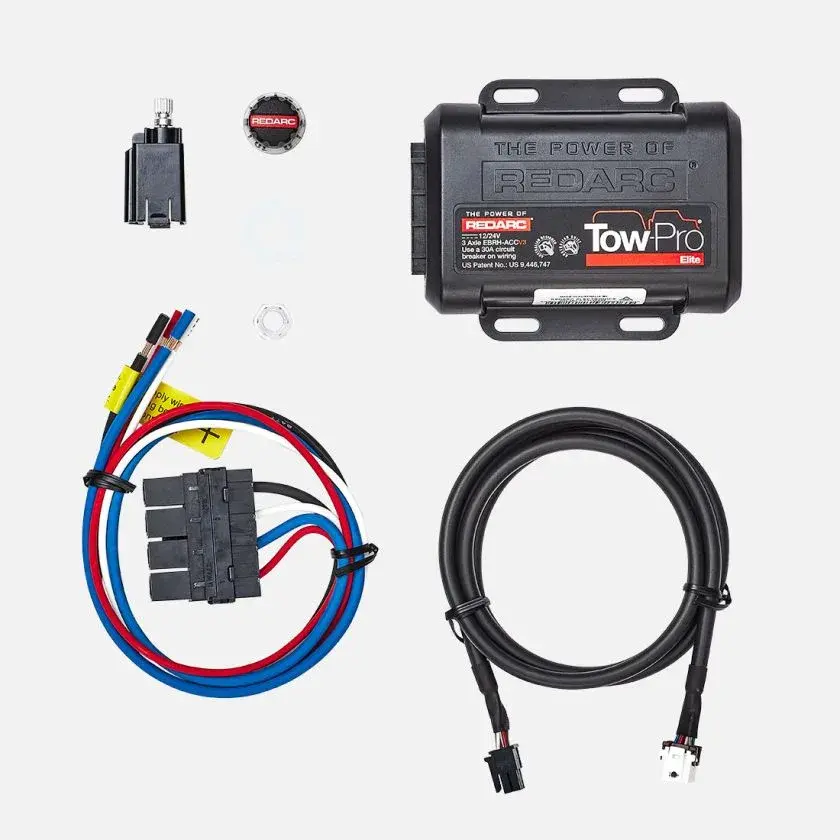
For example, products such as the REDARC Tow-Pro Elite are designed specifically for this type of application.
If you're looking for a REDARC Tow-Pro Elite V3 installation in Sydney, Sydney Auto Installs provides mobile installation at your home or workplace.
For a modern ute or SUV towing a large caravan, correct brake-controller selection and installation is an important part of building a compliant towing system.
Breakaway systems: another important requirement
If the trailer's GTM exceeds 2,000kg, NSW requirements also require an automatic breakaway system. The NSW Government confirms that trailers with a GTM exceeding 2 tonnes must have an automatic breakaway system. Read the NSW towing requirements.
Transport for NSW states that trailers with a GTM exceeding 2 tonnes must have an automatic breakaway system in case the trailer becomes detached from the vehicle.
The NSW vehicle registration regulations further specify requirements for the breakaway braking system, including automatic operation and continued operation after a breakaway.
This is particularly relevant to:
Large caravans
Heavy camper trailers
Plant trailers
Large enclosed trailers
Boat trailers
Equipment trailers
Why your towbar rating matters
A vehicle may be capable of towing 3,500kg, but that doesn't automatically mean every towbar fitted to it can.
Your towbar needs to be appropriately rated for the vehicle and application.
NSW requires towbar and coupling capacity not to be exceeded, and towbar markings are required for applicable vehicles.
Before towing, check:
Vehicle towing capacity
Towbar capacity
Coupling capacity
Trailer ATM
Trailer GTM
Tow ball mass
Tyre ratings
GVM
GCM
Axle load limits
Why accessories can dramatically reduce your payload
This is particularly important for touring dual-cabs.
A modern 4WD ute might have:
Steel bullbar
Winch
Side steps
Canopy
Roof rack
Roof-top tent
Awning
Drawers
Fridge
Second battery
Solar equipment
Recovery boards
Spare wheel
Water tanks
Camping equipment
Each accessory adds weight.
A vehicle that appears to have a generous payload when stock can have significantly less available payload after modifications.
This is why you should weigh the vehicle rather than guessing.
The best way to know your actual towing weights
If you're serious about towing, take your combination to a certified public weighbridge.
Ideally, obtain:
Vehicle weight without the trailer
Vehicle weight with passengers and normal touring equipment
Front axle weight
Rear axle weight
Trailer GTM
Trailer ATM where applicable
Combined vehicle and trailer weight
Tow ball mass where possible
You can then compare the actual measurements against the manufacturer's limits.
This is far more accurate than estimating how much your caravan or ute weighs.
Why "I can tow 3.5 tonnes" can be misleading
Consider two drivers.
Driver A
Toyota Hilux
Caravan: 2,500kg
Vehicle lightly loaded.
No major accessories.
Everything is comfortably within the manufacturer's limits.
Driver B
Ford Ranger
Caravan: 3,500kg
Steel bullbar
Winch
Canopy
Drawers
Fridge
Roof-top tent
Two adults
Two children
Full fuel tank
Tools
Recovery equipment
Water
Camping equipment
Spare wheel
The second combination can be dramatically closer to its limits even though the Ranger has a 3,500kg towing rating.
The trailer weight alone doesn't tell the whole story.
The golden rule of towing in NSW
Don't ask:
"Can my ute tow 3,500kg?"
Ask:
"Can my fully loaded vehicle legally tow my fully loaded trailer while staying within GVM, GCM, axle, towbar, coupling, tyre and manufacturer's limits?"
That is the question that matters.
A simple towing calculation you can do at home
Before heading away, write down:
Vehicle
GVM: ______ kg
GCM: ______ kg
Kerb/empty mass: ______ kg
Maximum towing capacity: ______ kg
Maximum tow ball mass: ______ kg
Vehicle load
Driver: ______ kg
Passengers: ______ kg
Fuel: ______ kg
Accessories: ______ kg
Cargo: ______ kg
Tow ball download: ______ kg
Actual vehicle mass: ______ kg
Trailer
Trailer tare/empty mass: ______ kg
Cargo: ______ kg
Water: ______ kg
Gas: ______ kg
Equipment: ______ kg
Actual trailer mass: ______ kg
Combination
Vehicle mass + trailer mass = actual GCM
Then compare that figure against your manufacturer's GCM.
If you're close to the limit, don't guess.
Get it weighed.
Don't forget your axle limits
GVM is not the only vehicle weight limit.
You can potentially be under your GVM while still placing too much weight on an individual axle.
For example, a heavy tow ball download can substantially increase rear axle loading.
This is why manufacturers such as Toyota specifically advise customers to consider GVM, GCM, kerb weight and individual front and rear axle load limits when towing.
Towing safely is about more than legality
Even if a combination is technically legal, towing at the maximum limit can change the vehicle's handling.
A heavy trailer can affect:
Braking distance
Steering
Acceleration
Cornering
Suspension
Tyre temperatures
Transmission temperatures
Stability
Trailer sway
Emergency maneuvering
NSW Government recommends allowing longer braking distances, avoiding sudden lane changes and using smooth steering, braking and acceleration when towing.
Before connecting your caravan or trailer, check:
Vehicle GVM
Vehicle GCM
Maximum towing capacity
Maximum tow ball mass
Front axle limit
Rear axle limit
Towbar rating
Coupling rating
Trailer ATM
Trailer GTM
Trailer brakes
Electric brake controller where applicable
Breakaway system for trailers over 2,000kg GTM
Safety chains
Tyre load ratings
Tyre pressures
Lights
Coupling locked correctly
Load secured
Actual vehicle mass
Actual trailer mass
Actual combined mass
The bottom line
Modern Australian vehicles such as the Toyota Hilux, Ford Ranger, Ford Everest, Isuzu D-MAX and Mitsubishi Triton are extremely capable towing vehicles.
But capability doesn't mean you can simply attach a 3,500kg caravan and drive away.
Your towing setup needs to be considered as a complete system.
GVM tells you how heavy your vehicle can be.
GCM tells you how heavy the vehicle and trailer can be together.
Towing capacity tells you how much the vehicle is rated to tow.
GTM and ATM tell you about the trailer's actual and maximum masses.
And when your trailer requires brakes, the braking system must comply with NSW requirements and be capable of being operated correctly by the driver.
If your trailer uses electric brakes, an appropriately selected and installed electric brake controller is an essential part of the towing system.
The safest approach is simple:
Know your numbers. Weigh your combination. Never assume that the advertised towing capacity tells you the whole story.
If you're unsure whether your vehicle, caravan or trailer setup is correctly equipped, have the combination assessed before you head away.
Sydney Auto Installs can help with professional electric brake controller installations, including REDARC Tow-Pro systems, for caravans, trailers and towing vehicles across Sydney.
Important disclaimer
This article is intended as general information only and is not a substitute for checking the specific manufacturer's specifications, your vehicle's compliance plate, trailer documentation, current NSW legislation or professional engineering advice.
Vehicle specifications can vary between model years, variants, drivetrains, accessories and factory options. Always confirm the exact limits applicable to your vehicle and trailer before towing.
Sources and legislation
The information in this article has been checked against current NSW Government towing guidance, NSW legislation and manufacturer information available in 2026.
Relevant legislation and guidance includes the NSW Road Rules 2014 and Road Transport (Vehicle Registration) Regulation 2017, together with Transport for NSW towing requirements.
Need an Electric Brake Controller in NSW?
Understanding your towing limits is only the first step. If your caravan or trailer requires an electric braking system, the brake controller needs to be correctly selected, installed, wired and calibrated for your vehicle and trailer.
Sydney Auto Installs specialises in mobile electric brake controller installation across Sydney, including REDARC Tow-Pro Elite V3 installations on modern 4WDs, dual-cab utes and SUVs.
We install brake controllers for vehicles including:
Toyota Hilux
Toyota Prado
Toyota LandCruiser
Ford Ranger
Ford Everest
Isuzu D-MAX
Isuzu MU-X
Mitsubishi Triton
Nissan Navara
Mazda BT-50
Volkswagen Amarok
And other towing vehicles
Book an electric brake controller installation in Sydney or learn more about our REDARC Tow-Pro Elite V3 installation service.
Official NSW Towing Resources
For the most up-to-date information on towing requirements in NSW, vehicle owners should refer to official NSW Government and Transport for NSW resources:
NSW Government – Towing a trailer or caravan. – towing rules, vehicle and trailer requirements, braking systems, towbar requirements and loading.
NSW Government – Modifying trailers in NSW – trailer GTM, ATM and braking-system requirements.
Transport for NSW – Caravan Safety – caravan loading, towing safety and pre-trip checks.


Comments